
hard2play

hard2play/In development

The Grind

Read the people, not the cards.

Poker where the cards are only half the information. The other half is sitting across the table, and it has a habit.

  • Portrait, one hand
  • Plays offline
  • Phone & tablet
Coming soon to Google Play Coming soon to App Store

Free: the prologue and the training table. The full game unlocks with one purchase — no subscription, no ads, no in‑game currency.

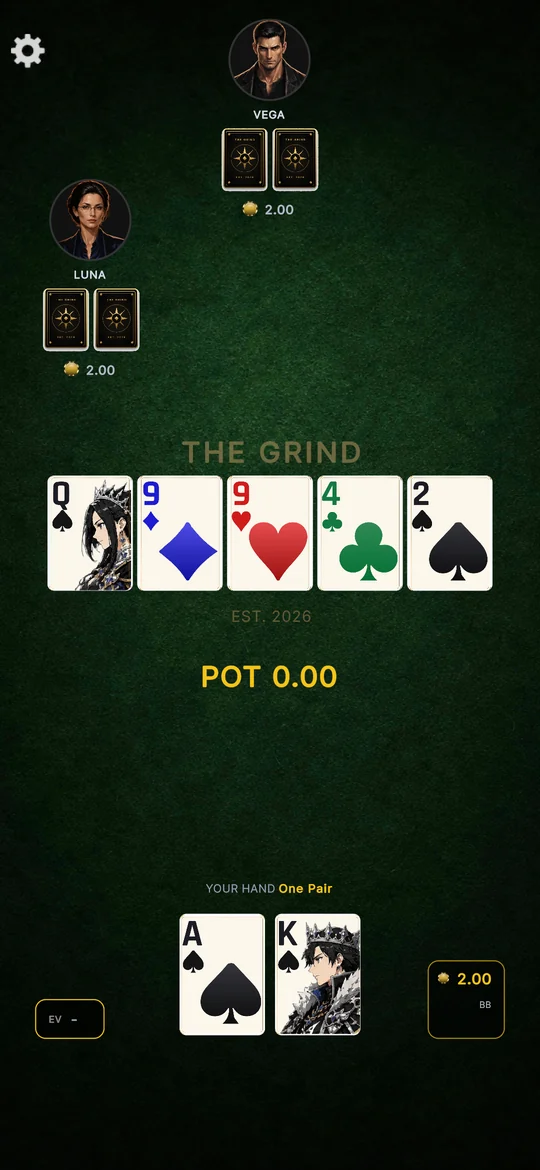
This is not a poker simulator

Poker is the price of entry.
The people are the game.

More than an EV trainer

Solvers will teach you the move that is right against everybody. This teaches the move that is right against this person: find the leak in the player opposite you, then bet into it on purpose. Correct poker gets you a seat. Reading the table is what takes the chips.

Graded on the decision, not the pot

Every action you take is scored against what it was worth, not against whether the hand came in. The game will tell you, plainly, that you played it correctly and still lost — and that you won a hand you had no business winning. Those are different things, and the difference is the whole subject.

Opponents are people, not sliders

Twenty-two recurring characters, each carrying one observable habit: how they bet, when they go quiet, what they do when it hurts. Name it correctly once and that person is solved for the rest of the campaign — and they are working on you at the same time.

The core loop

How a read works

Reads run in parallel with the poker and never touch your stack. They are hypotheses, and the game refuses to score them until the table is finished.

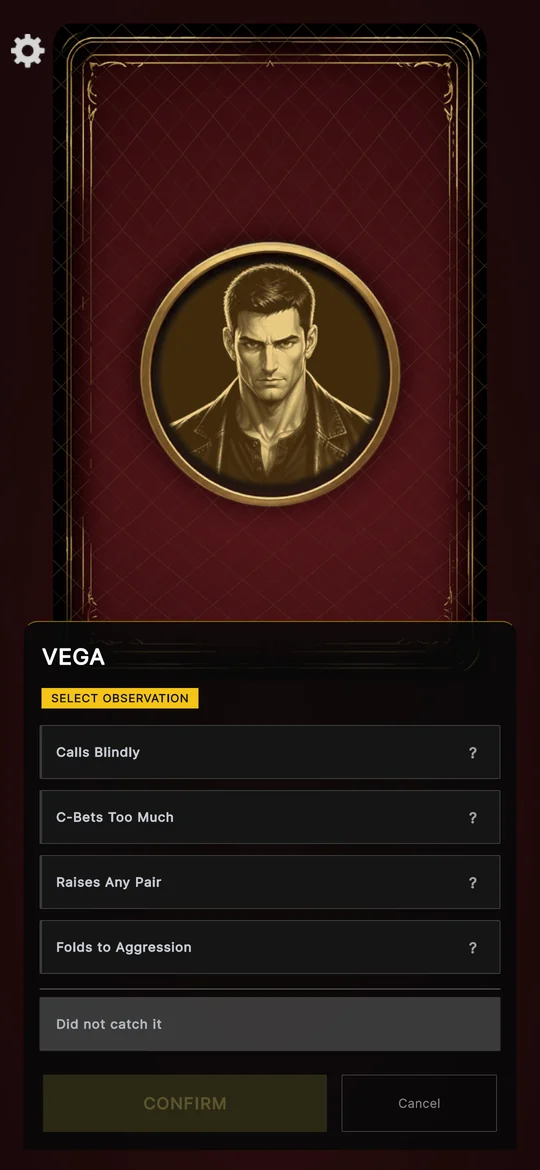
  1. Watch

    The coach flags something he has seen more than once — seat three keeps folding to pressure — and opens the trait picker. He never tells you the answer.

  2. Draft

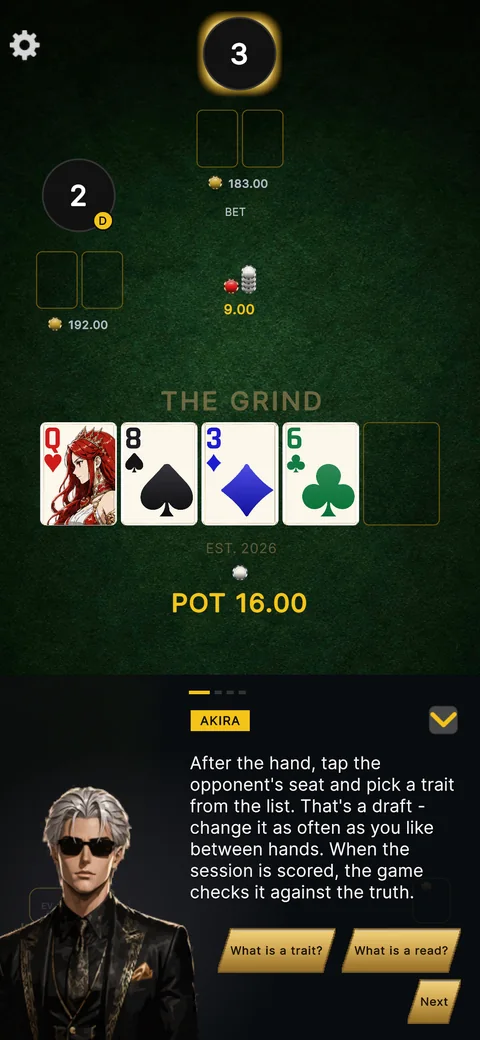
    You name the one habit you believe defines that player. A draft is private, costs nothing, and can be re-tagged if you change your mind.

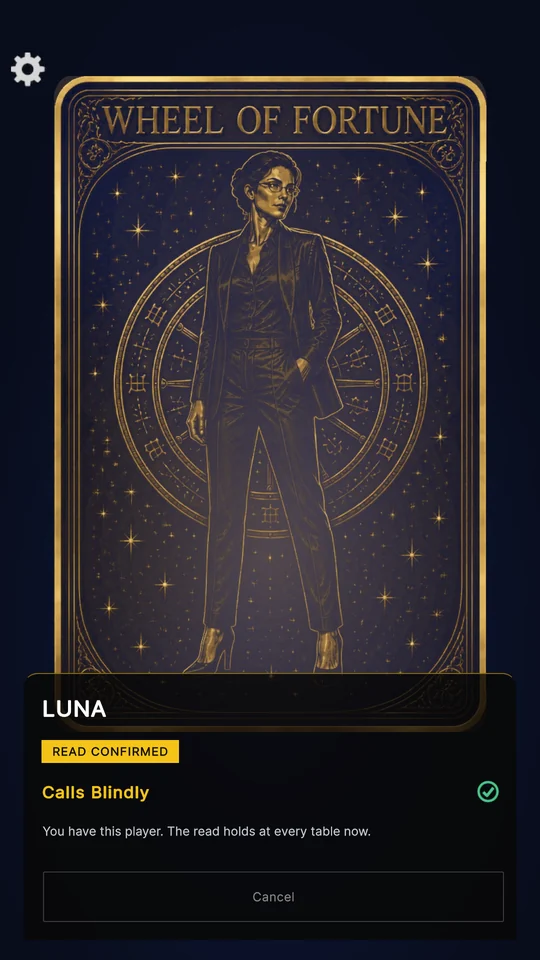
  3. Confirm

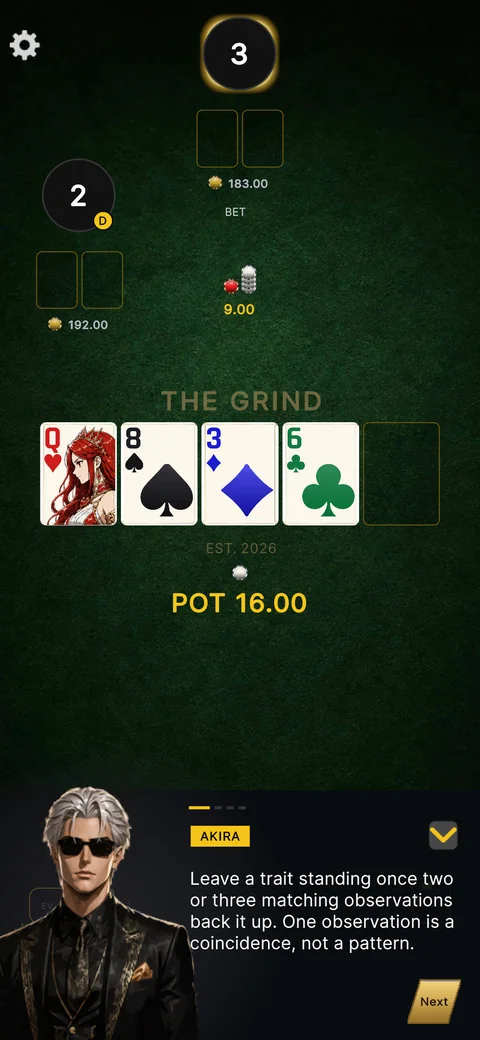
    Once enough hands have actually shown the behaviour, the read locks. Accuracy appears only when you clear the table, so you can never grind feedback out of it.

  4. Keep

    A correct read pays a permanent bonus and retires that person for good. Their card turns face-up in the coach’s index and stays that way at every table after.

A face-down card carrying Vega's gold portrait medallion. The arcana card The Chariot, showing Vega.

Seat 3 · Vega

Identify player

He has bet the flop nearly every hand he opened, whatever came down. Pick the habit that defines him.

Learning to tell them apart

The coach teaches,
then gets out of the way

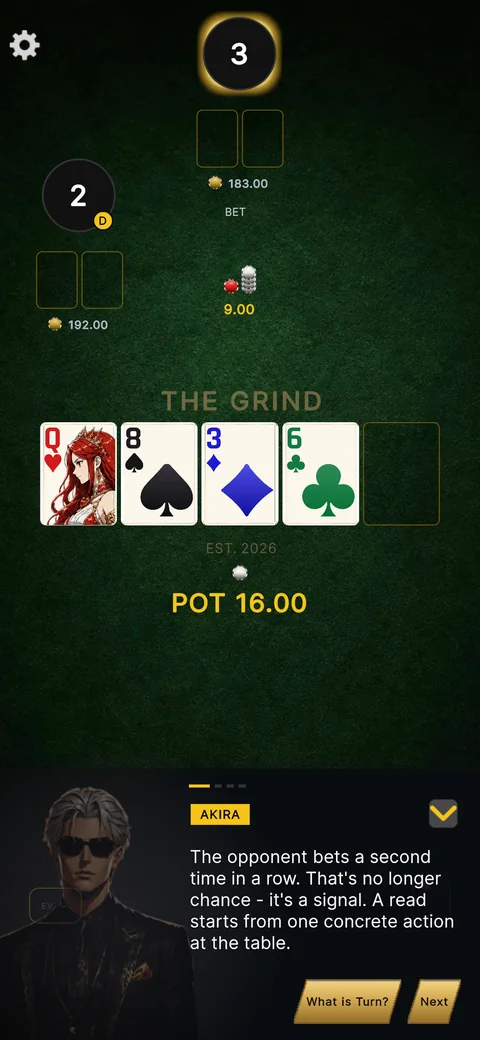
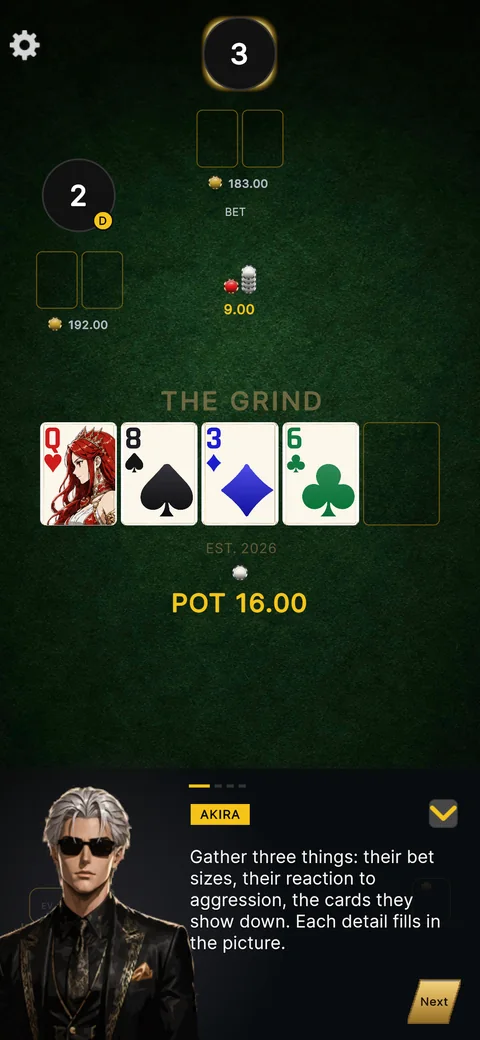
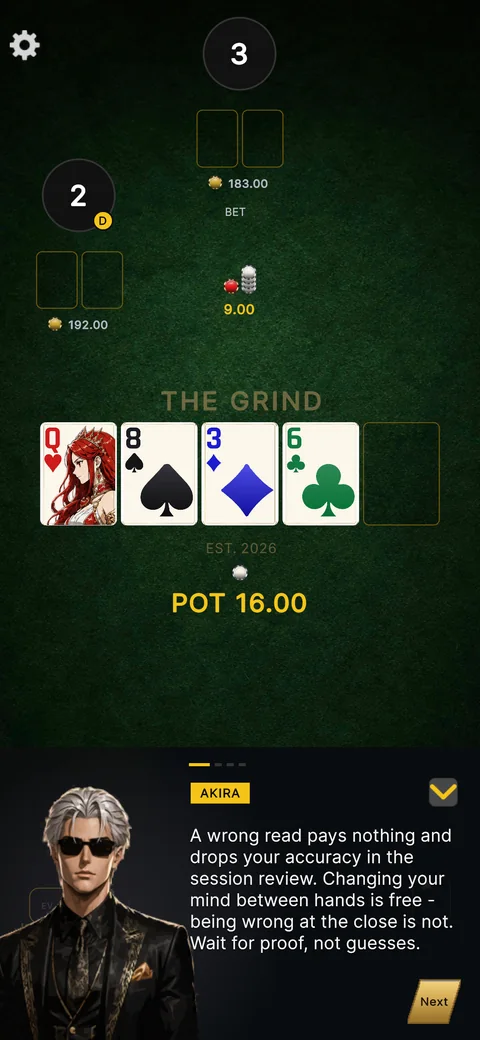
Twenty habits look alike until somebody shows you the difference. So the game teaches them — on a frozen training hand, with the board and the seats laid out, and Akira talking you through what just happened.

Lecture How a read is built
Lecture beat one: the frozen training hand, seats two and three as numbered discs with their hole cards, and Akira explaining that a second bet in a row is a signal.
  • Twenty-eight lectures, on your terms. Eight on the concepts — the rules, hand rankings, position, pot odds, expected value — and twenty on the specific habits you are learning to spot. Nothing interrupts a live hand; everything is replayable from the hub.
  • The language, too. Check, c-bet, the nuts, a float, a squeeze, the button. Any term the coach uses can be tapped for a one-breath definition that returns you to exactly the beat you were on. You never have to leave the game to look up a word.
  • Starting from the actual rules. If you have never played hold’em, the first lectures deal you a hand and explain what a street is, who acts when, and why the same cards are worth more from one chair than another.

The cast

Twenty-two people,
twenty-two cards

The coach keeps an index. Every recurring player in the game is one card of the Major Arcana in it — face-down behind their own portrait until you have read them, face-up forever after. Drag the deck.

One card in the deck does not play by these rules. It has no habit of its own — it plays yours back at you, and it only confirms when you can name the two traits that describe your own game. You will know it when you sit down.

The climb

Fourteen tables,
one bankroll

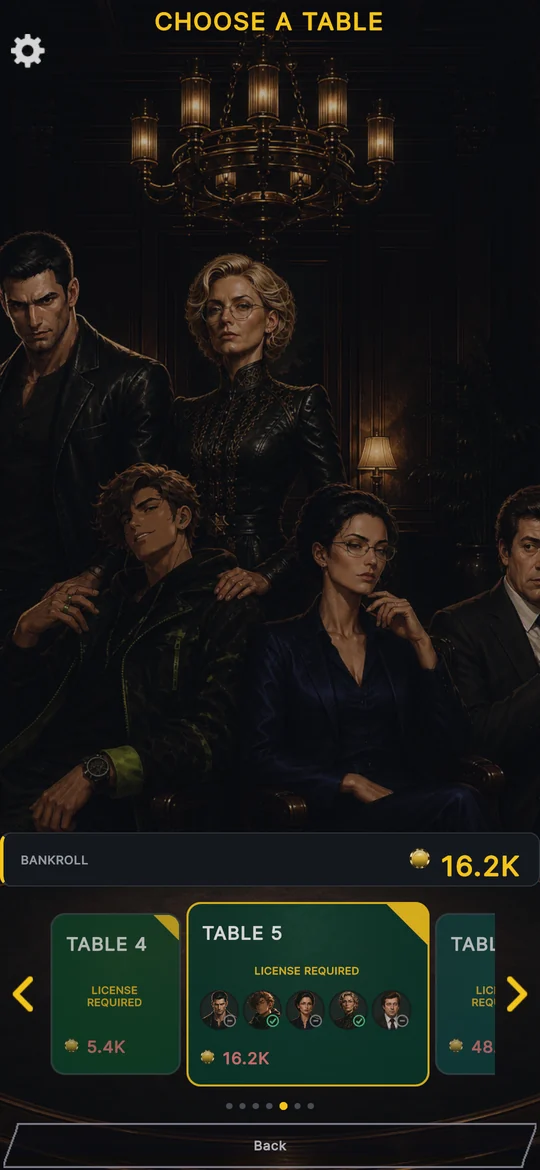
A run, not a level select. One wallet carries the whole campaign, every rung triples the buy-in, and busting drops you back down to rebuild — but the reads you confirmed are yours to keep, so you come back up knowing the room. The training table is always free to sit at, so the floor never locks you out.

  1. L0200Vega, Luna — the classroom
  2. L1600Rex joins
  3. L21,800Laska joins
  4. L35,400Axel, Tamara
  5. L416.2KThe Wanderer
  6. L548.6KRyuk, Raduga, Cherry
  7. L6145.8KYukti, Linda
  8. L7437.4KMirage, Beatrix
  9. L81.31MNova, Eira
  10. L93.94MFather Yusuf, Amon
  11. L1011.8MMirov
  12. L1135.4MThe Falcon
  13. L12106MA boss with a manufactured tell
  14. L13319MHeads-up. No one else at the table

Buy-in to sit down, in chips. Colour is the felt that table is played on.
Chips are virtual. There are no real stakes and no real winnings in this game, and there never will be.

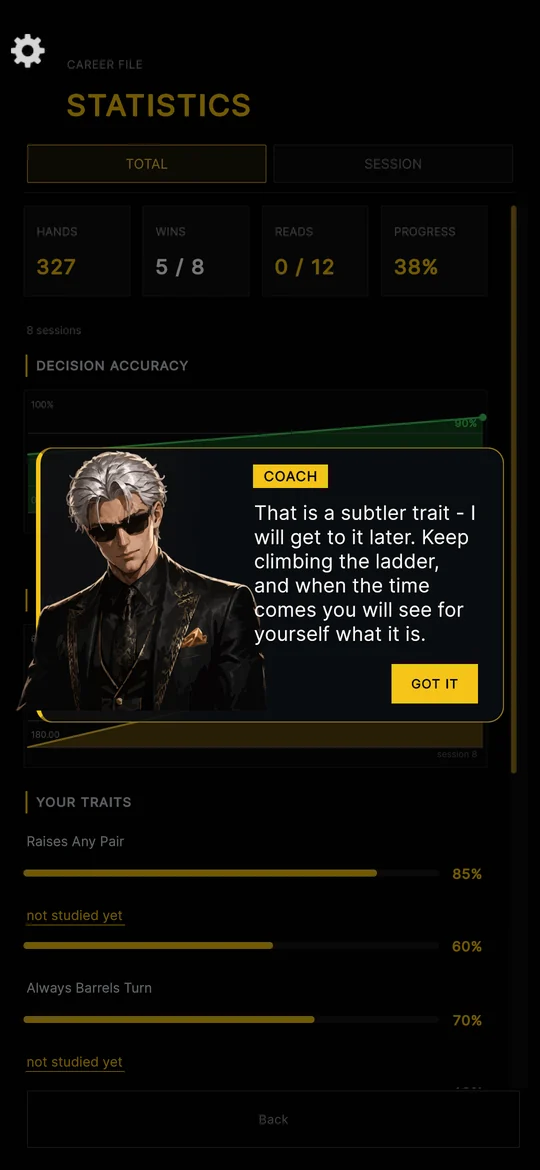
The career file showing YOUR TRAITS as percentage bars, with the coach explaining one of them.

The other side of the table

You have tells too

The game runs the same analysis on you that you are running on everyone else — and then it shows you the file.

  • Your habits, measured. Raises any pair. Folds to aggression. Barrels every turn. Your own dominant traits are tracked as percentages and listed by name, in the same vocabulary you use to read everyone else.
  • Your leaks, named out loud. Once a session, when he has actually earned it, the coach stops and tells you the one thing you keep doing wrong. Not a tip list — the specific mistake you made three times tonight.
  • And they can see it. The table reacts to how you play. Fold too often to pressure and somebody will say so, out loud, and then start pressuring you. Your profile is not private.

The living table

People who talk back

Nobody at this table is a silent avatar. They comment on the hand you just played, needle the player who has been running hot, go quiet when it hurts, and make each other offers you are welcome to overhear.

Table talk

Short, seat-anchored lines that land between hands: a read on you, a reaction to a scary board, a jab after a bad beat, a rivalry that builds over a session. Painted portraits animate as they speak, and the felt gets a little louder the higher you climb.

Buying a look

Heads-up in a hand, money can move sideways. An opponent will offer to sell you a peek at one of their cards — and you can offer to buy one. Either side can refuse, or haggle: name a different price and see whether the other one blinks. Fold to a big bet and the winner may offer to show you the whole hand, for a toll.

The blind hand

Once per visit somebody stops the game and proposes one hand played completely blind — nobody looks at their cards. He names one price for the table and a different one for you. Everyone answers for themselves, and you answer last, knowing exactly who is in and how big the pot has become. The cards are provably random, so the only thing you can judge is the price.

The trainer

One honest number

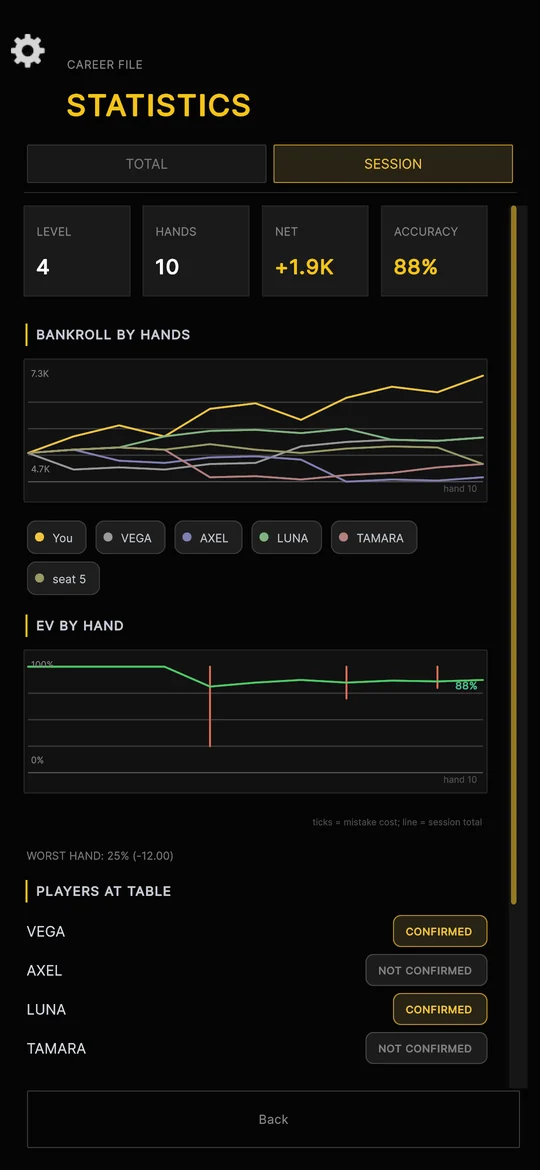
Every decision you make is graded and folded into a single accuracy score. The same figure drives the thermometer on the felt, the stat tile, the session graph and the coach’s tone — so when he says your percentage slipped, he is pointing at the number you can see.

The statistics screen: level, hands, net result and 88% accuracy, above a bankroll-by-hands graph and an EV-by-hand chart.
  • Expected value, per decision. Fold, call and raise are each measured against the pot odds and your real equity, then costed in chips. A bad call is expensive whether or not the river saves you.
  • A session you can walk back through. The recap freezes the table at the hands that mattered — the costliest mistake with its outs and odds, a leak you repeated, the pot you should not have won — and the coach talks you through each one.
  • Honest poker. The deck is shuffled and dealt straight, the same for you and for them. No rubber-banded odds, no draw that arrives because the story needs it, nothing for sale that improves your hand.
  • Discipline is paid even when you lose. Clean decisions earn a bonus at settlement regardless of the result — capped so that it can never turn a losing night into a winning one.

The campaign

It starts with an exam
you finish early

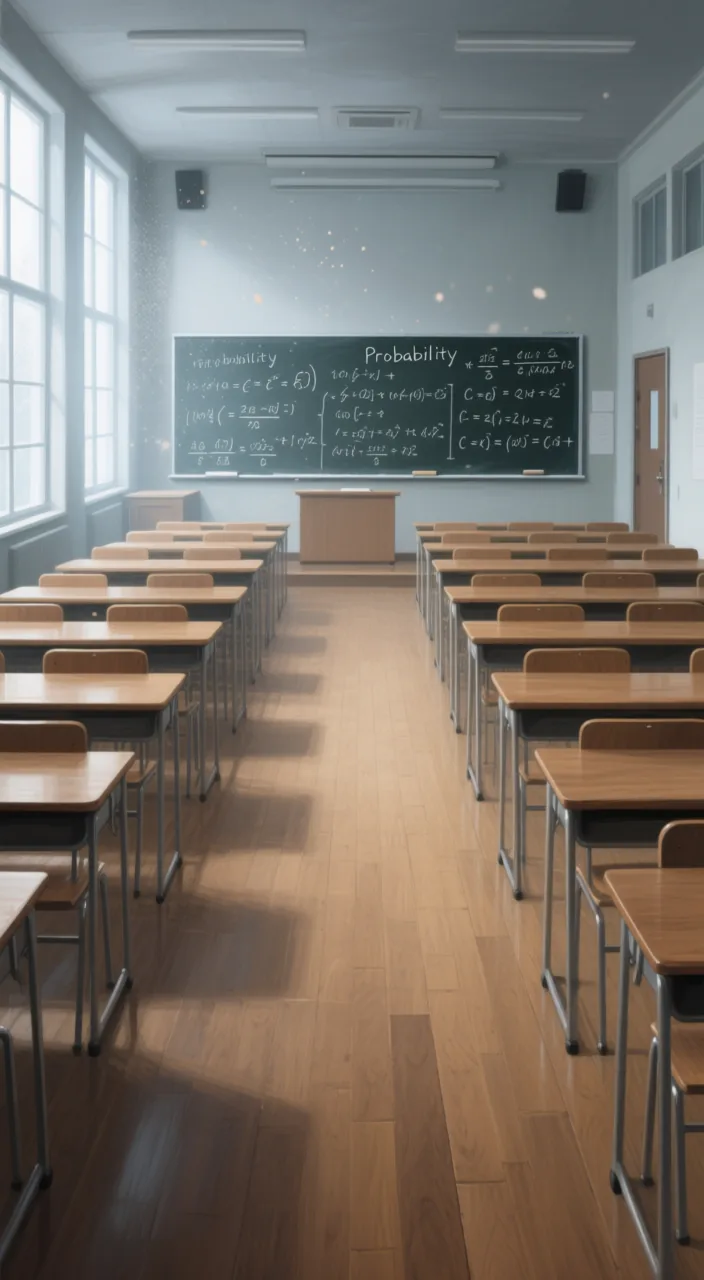
A probability paper, a lecture hall, and somebody in the back who has been watching how fast you work. What follows is a climb: a cinematic interlude between every rung, a cast that reappears and remembers how the last table went, and a coach whose reasons for helping you are his own business.

The rooms change as you go up — a back bar, a private club, a room with nothing in it but a table. The people change less. By the top you will have played most of them enough times to know what they do when it stops being fun, and you will find out what that says about you.

  • 22hand-painted characters
  • 119cinematic plates
  • 28lectures
  • 10languages

Screens

From the build

The deal

You buy it once

The offer appears exactly once, at the door of the first real table, and it is the only thing in the game that is ever for sale.

Free, before you decide
The prologue, the training table and the scene that walks you to the first real door. Statistics, achievements and the session recap are never locked.
One purchase, forever
Unlocks every table above the first and the whole campaign behind that door. Tied to your store account, restorable, and never asked for again.
Plays offline
The entire game runs with no connection, in portrait, on phones and tablets. Your progress lives in a save file on your device.
No advertising
Not between hands, not for a reward, not anywhere.
No subscription, no currency
Nothing to top up, no chips to buy, no energy, no timers, no second paid screen.
Nothing you can buy helps you win
Access is the only product. Selling an edge in a game about making good decisions would destroy the subject.

Sit down

The Grind is in development at hard2play. Android first, iOS after.

Coming soon toGoogle Play Coming soon toApp Store